Case study HW-RD-2026-04
Brownies & Ice Cream. A report from the bench.
Thirty-one numbered pours, one biscuit, a closed car, and a jar we are not allowed to refill. What we measured on the way to a candle that smells like the end of dinner, and what the measurements turned out to be for.
San Francisco, Saturday, October 17, 2026. Hale & Wick today releases the research record for Brownies & Ice Cream, the first new house scent since Mission Fig in 2019. The candle went on the shelf on October 6. The work started on August 4, 2025, when June Hale asked for a smell and Martin Wick asked for a number. This document is the number, and the smell, and the parts that were neither.
The target was specific. June wanted the moment after a good dinner when the plates are gone and nobody has stood up, and someone is about to ask whether there is anything else. Martin wanted the cost of goods under eleven dollars. The panel, which is the staff, wanted to be able to say what they were smelling without using the word delicious, because delicious is not a note and has gotten us in trouble before.
“I asked for the end of a good dinner. I did not ask for a mall, a church basement, or a car. We visited all three. We kept the dinner.”
June Hale, Co-founder, Head of Pour
We poured thirty-one tests. Most were on Thursdays, after the Tuesday batch had cured and the room was quiet enough to trust a nose. The exceptions are in the log. One exception is a biscuit. One is a Civic. One is a pint of ice cream we placed next to a flame in order to learn something ice cream is not for, and then ate, because the test was over and the ice cream was not going to improve.
The approved candle weighs 241.0 grams in our book and 8.5 ounces on the label. It carries 21.7 grams of fragrance, of which 0.18 grams are cocoa absolute from lot GA-2208 and 20.17 grams are the carrier that makes the rest of the sentence possible. It is not food. Putting 0.2 grams of batter into pour 27 did not make it food. That is how we know the sentence is a material fact and not a slogan.
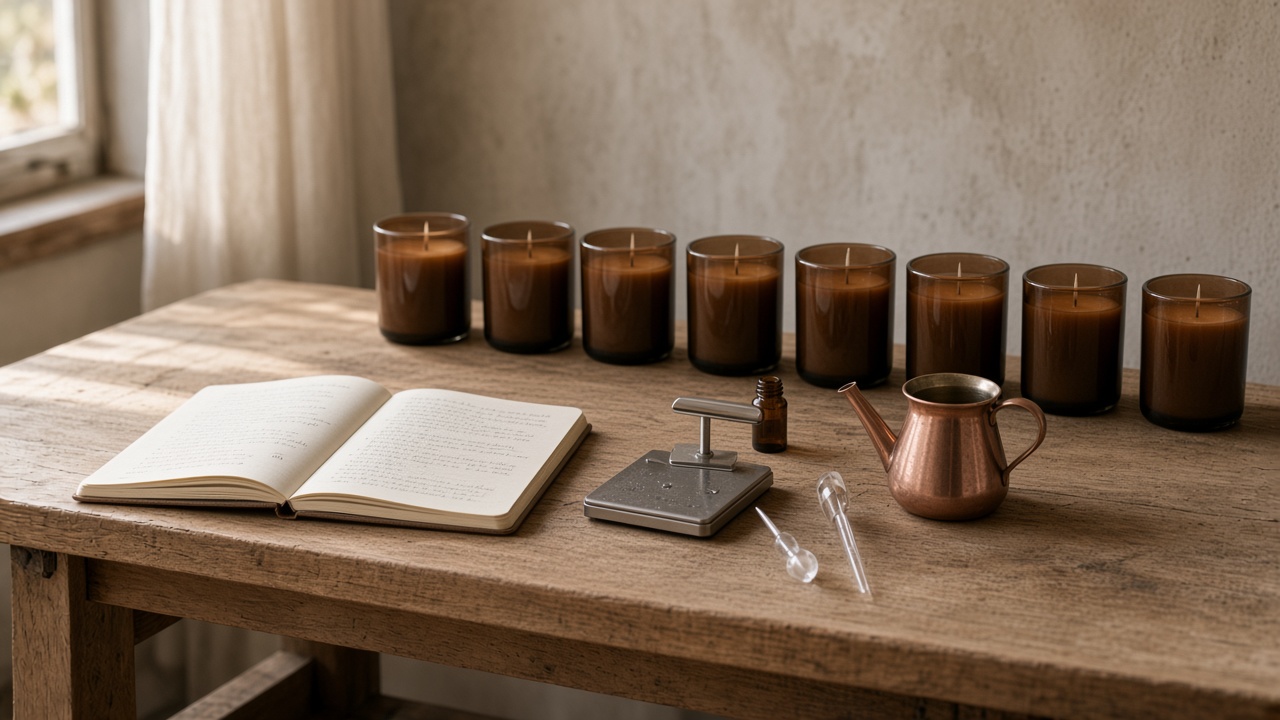
A word about the room, because every number below happened in it. The front room is 9 feet by 11, with a 10-foot ceiling: 990 cubic feet. We test after the shop closes, with the heat off, because the heat has opinions. The window latch on the Vallejo side sticks at an inch and a half. On November 13 we stopped trying to open it further and wrote 1.5 inches into the method. Martin measured the gap with a matchbook. The ruler was in the pour room, where it still is, and where it is now used for wicks.
“The target was eleven dollars. We arrived at eleven dollars and thirty-seven cents, and at four pounds, which are not dollars, and which I wrote in the same column anyway.”
Martin Wick, Co-founder, Operations
The four pounds are a mean. June gained 4, Martin 2, Teodora 6, and, though they were not in the original brief, Ruben 3 and Lise 5. The mean of the five is 4.0. The mean of the original three is also 4.0, which Martin noticed at 4:46 p.m. on the day of the vote and which he has declined to call a coincidence in writing. Pepper was not weighed. She attended in the way she attends, which is to say she was present for the biscuit and asleep for the decision.
Results
By the numbers.
- 31numbered test pours, August 2025 to July 2026
- 14 mo, 2 daysfrom the brief to the shelf, August 4 to October 6
- $11.37cost of goods, against a target of $11.00
- 4.0 lbmean weight gained by the team, recorded anyway
Full metrics
- Document
- HW-RD-2026-04. Case study. Not a recipe, and not food.
- Brief
- Monday, August 4, 2025, 9:10 a.m. June asked for the end of a good dinner. Martin asked for a cost of goods under $11. Both were written down before anyone agreed.
- Approved
- Thursday, July 16, 2026, 4:41 p.m. 346 days after the brief. Five yes, zero no, one abstention.
- On the shelf
- Tuesday, October 6, 2026. Fourteen months and two days after the brief.
- Finished weight
- 241.0 grams in the lab. 8.5 ounces on the label. The difference is rounding, and it has already been reported to us by a person who was not in the room.
- Wax
- 219.3 grams per glass. Soy 198.5 grams, beeswax 20.8 grams, or 9.5 percent beeswax.
- Fragrance
- 21.7 grams per glass, a 9.0 percent load. Of that: cocoa absolute 0.18 g, vanilla 0.22 g, brown-butter accord 0.94 g, walnut 0.11 g, tonka 0.08 g, and 20.17 grams of carrier.
- Cocoa absolute
- Lot GA-2208, Ashanti region, through the importer in Oakland. 7.2 grams per forty-glass batch, at $7.15 a gram.
- Salt
- 0.04 grams per glass, in the wax, not in the oil. A pinch, weighed, so that it would stop being a pinch.
- Test melt
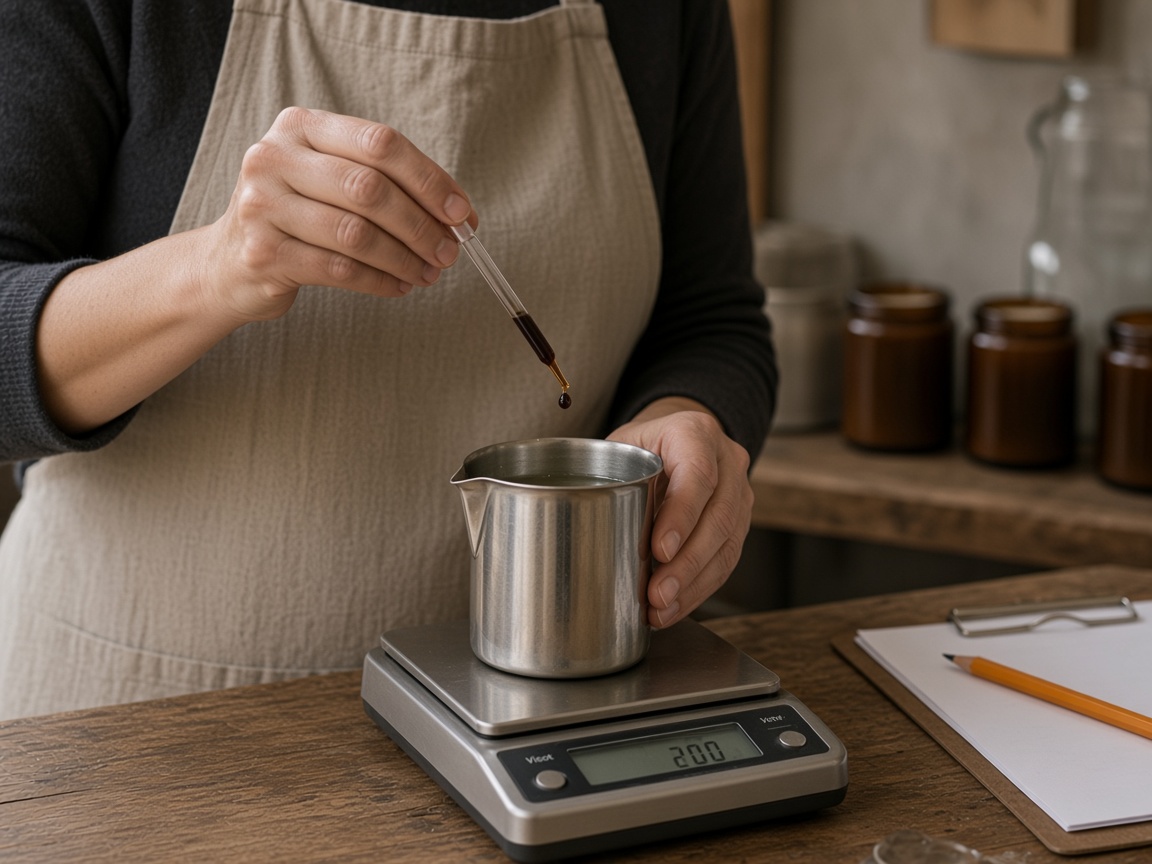
- 113.6 grams of wax in a beaker of 86.4 grams. The bench scale then read 200. It reads in whole grams. This became a photograph.
- Room
- Front room, after hours. 9 by 11 feet, ceiling 10 feet, 990 cubic feet. HVAC off. The window latch sticks at 1.5 inches, which is now the method.
- Standing day
- Thursday, after the Tuesday batch had cured. Exceptions are in the log, and each one has a reason, including the biscuit.
- Panel
- June, Martin, Teodora, Ruben, Lise. Gerald kept time on July 16 and was not a voter. Teodora’s aunt in Bernal Heights smelled pour 11 and was not told why.
- Cold throw, pour 31
- At 6 inches, immediate. At 3 feet, 4 minutes 10 seconds. At 11 feet, June at 12 minutes 20 seconds. Martin, at 11 feet, never, across 20 minutes. Recorded as “detectable by June.”
- Hot throw, pour 31
- Door closed: the room at 18 minutes 30 seconds. Door open 1.5 inches: the room at 41 minutes 0 seconds. Lise called the 41 from the hall. It was not rounded.
- First melt pool
- 2 hours 51 minutes to the edge of the glass. The care card says about three hours. Both numbers are in the file.
- Refrigerator
- During the 3 hour 6 minute approval burn: 13 openings, by 4 people. 4.2 openings per hour. Pepper does not have refrigerator privileges, and did not acquire them.
- Weight
- June 4 lb, Martin 2, Teodora 6, Ruben 3, Lise 5. Mean of the five, 4.0. Mean of the brief’s three, also 4.0. Pepper was not weighed.
- Snacks
- $86.92 in reference brownies and one pint of ice cream, amortized across the first 212 glasses, because 212 was a number we already trusted. $0.41 per glass.
- Cost of goods
- Glass $3.10, wax $2.35, wick $0.22, fragrance $4.15, labor and overhead $1.14, snacks $0.41. Total $11.37. Martin conceded at 4:52 p.m., eleven minutes after the vote.
Trials
What we went through, in the order it happened.
The short version is on the candle’s own page. This is the long version. The times are the times. Where a measurement seems not to have been worth taking, it was taken anyway, and it is here, because leaving it out would be a second decision and we were tired.
Powder, then a car
From August 19 through October 30 we worked with cocoa powder, because the absolute had not arrived and because powder is what a person reaches for when they are thinking of a brownie and not yet of a formula. Pours 1 through 5 were still on Tuesdays, which is batch day. They smelled like paper, then like a drawer, then like a pretzel that had been told about chocolate at a party: polite, and inedible in the correct direction. After pour 5 we moved the tests to Thursday. A batch day has too many other smells in it. March 3 was a Tuesday again, which is part of why March 3 happened. Pour 6, on October 9 at 11:16 a.m., was the first one June did not apologize for. Dutch-process cocoa, bloomed in the wax for twenty minutes at 185°F. Teodora smelled it and had a reaction she later classified as professional.
Pour 7 was pour 6, taken for a drive. We did not light it. We would like that to be the sentence people repeat. On Thursday, October 16, 2025, June’s Civic, model year 2008, was parked at Vallejo and Jones, clear of the driveway with the blue door. A thermometer from the pour room was taped to the dash. At 2:14 p.m. the cabin was 71°F. At minute 27 it was 109°F. At minute 41, 2:55 p.m., we took the candle out. The windows had been up. The candle had been a candle the whole time. It smelled like a brownie that had given up on being served.
We aired the car for six days. On day two, June’s partner asked if she had started driving for a bakery. She said she had not. This was true, and it did not answer the question he was actually asking, which was about the car. On day six the car smelled like a car. We wrote the baseline down then, which is late for a baseline, and we have not repeated the test. Powder was finished as a path on October 30. The baking sheet in the note for pour 9 was not a real baking sheet. We have a real one. It was clean.
The shipment, and a basement
Cocoa absolute is a thick, dark material, and a little of it is the whole idea. Our lot is GA-2208, from a Fairtrade cooperative in the Ashanti region, through the importer in Oakland who visits the growers twice a year. We use 0.18 grams in a glass and 7.2 grams in a batch of forty. At $7.15 a gram, the batch’s cocoa is $51.48, or $1.29 of the $4.15 we spend on fragrance. The rest of the fragrance money is vanilla, a brown-butter accord, a little walnut, a little tonka, and 20.17 grams of carrier. The carrier is the part a customer will never be told about in a shop, and it is most of the grams. We are telling you because this is the report and not the shop.
Before the lot arrived we had a sample. On December 4, Teodora took 0.2 grams of it in a 100 gram melt to her aunt’s kitchen in Bernal Heights, which is adjacent to the Mission and has already been discussed, in another context, on the forum. Her aunt was not told the brief. She said the kitchen smelled like the church basement, but kindly. We kept the kindly. The basement took longer to leave. Pour 12, a week later, was ashy, and the morning was 92 percent humidity, and we could not tell the dose from the weather. We eventually blamed both, which is allowed when you write it down.
January 8 is the day the drum of the real lot was opened. June wrote “yes” and left three blank lines, which Martin does not permit and did not contest. The formula in the fourth line is the cocoa dose we still pour.
Brown butter, measured
Butter is not in the candle. This will matter later, when a jar on a high shelf enters the story. What is in the candle is an accord built to smell like butter that has been taken seriously. To know what that was, June browned 227 grams of unsalted butter, two sticks, in the saucepan we use for nothing else. It took 6 minutes and 12 seconds to reach the color of a manila folder. We chose the folder because “amber” was already a word we use for a glass, and we did not want two ambers in one notebook.
A cotton wick was held eight inches above the pan for 45 seconds. The wick then smelled like brown butter for three days. It was put in a jar with tape on it. On day two Ruben picked it up for a Sonoma Hive, stopped, and said the hive smelled like breakfast. It does not. He had smelled the wick on his fingers. The hive was fine. The wick was moved to the high shelf, which is becoming a neighborhood.
Pour 17, February 12, 1:15 p.m., put the accord next to the cocoa at the dose we still use, 0.94 grams to a glass. The panel’s note was “breakfast near a brownie.” We were close enough to become careless, which is the condition under which pour 18 happened.
Incident
March 3, the biscuit.
Pour 18 was a Tuesday, which was already against the Thursday rule. The scale was on the bench because Tuesdays are batch days. A chair was pulled out. At 11:07 a.m. Ruben weighed cocoa absolute to the number in the notebook. The number was 4.1 grams. A test melt wants 0.09. He poured it. The melt was wrong in a way the room could smell before anyone did the division.
The 4.1 grams had been a biscuit, weighed earlier, eaten by the time the column was read. Pepper had put the biscuit on the scale. We did not see her do it. We know because the biscuit was hers, the chair was out, and the distance works: bench 36 inches, shoulder 17, chair 18, and one inch of determination. The wrapper, weighed Wednesday at 9:40 a.m., was 0.4 grams. We include it because we weighed it.
Five whys
- Why was pour 18 destroyed? The melt contained 4.1 grams of cocoa absolute. The card called for 0.09 grams. At $7.15 a gram, the cocoa alone was $29.32, and the wax brought the loss to $30.54.
- Why was 4.1 grams added? The notebook said 4.1, in the cocoa column, and Ruben follows the notebook. This is a virtue every day except March 3.
- Why did the notebook say 4.1? Teodora wrote down the number on the scale. The cocoa column was the next blank column. She was in a hurry, and the number was sitting there, looking like work.
- Why was 4.1 the number on the scale? A biscuit was on the scale. It weighed 4.1 grams. By the time anyone understood the sentence, Pepper had eaten the biscuit. The wrapper, weighed the next morning, was 0.4 grams, and was not a useful control.
- Why was the biscuit on the scale? Pepper put it there. The bench is 36 inches high. Pepper is 17 inches at the shoulder. A chair of 18 inches had been left pulled out, which comes to 35, and a biscuit will close an inch.
No one was written up. Pepper was not interviewed. The chair was pushed in at 9:55 a.m. on March 4, and the card now says that a number on a scale is not a number in a formula until a person has asked what is being weighed. This sounds obvious. It was 4.1 grams of obvious, at $7.15 a gram, plus $1.22 of wax, which is $30.54, and the end of our interest in guessing.
Mall, then Sunday
Vanilla arrived in April. The first time we used it, the pipette was still sticky from the brown-butter accord. Pour 19, April 2, 3:33 p.m., delivered 0.80 grams where the card said 0.22. The room smelled like a cupcake shop in a mall. Martin wrote the word mall and underlined it twice, which is the most emphasis he permits himself in ink. We washed the pipette. The wash is a line on the card now, between “weigh” and “record,” where memory had been standing in for a step.
On April 9, at 11:42 a.m., June bought a brownie on Polk Street for $4.75. It was still warm. We set it beside pour 17, not beside the mall, because we already knew what the mall was. A stockist from Petaluma was in the shop and rated the brownie a 6. He had been asked to rate the candle. He said the candle was more convincing, and then he asked if he could have a piece of the brownie, which was a research brownie and also, by then, missing a corner. We said yes. The rating stood.
Pour 21 brought the vanilla back to 0.22 grams. The ice cream note arrived, stayed for nine minutes, and left. Teodora wrote “it waved.” We spent part of the afternoon looking for a more technical verb. There is not one. Cold cream and vanilla, at the right dose, announce themselves and then let the cocoa speak. That is the whole trick, and it is annoying to describe, and pour 22 is when it held still.
April 22 was a Wednesday, not a Thursday. The humidity was 41 percent, which we had been waiting for, because at 92 percent the cocoa goes muddy and we did not want to meet Sunday in a mud. Teodora was not told the target. She smelled the melt at 2:11 p.m. and said “Sunday” at fourteen seconds. She did not say which Sunday. We did not ask. Pour 23, on May 7, repeated the formula to find out whether Sunday had been a mood of Teodora’s. Ruben called it a different Sunday. We counted that as a yes.
“Sunday. Fourteen seconds. I would like that to be the whole report.”
Teodora Vance, Counter Lead
The photograph from 2:11 is the scale. Martin wanted proof that the beaker, and not the wax, was the heavy object in the tare. The beaker was 86.4 grams on the jewelry scale. The wax was 113.6. The bench scale, which reads in whole grams, said 200. The drop of cocoa absolute above the beaker weighed 0.09 grams. It could not move a whole-gram instrument, before or after it landed. Martin took the photograph anyway and wrote “proof” on the back. It is proof that the bench scale is a whole-gram scale. We have left it in the file. He is right that it is the loose thread. A loose thread that does not change a result is still a thread, and this report is where we keep those.
The ice cream, used incorrectly
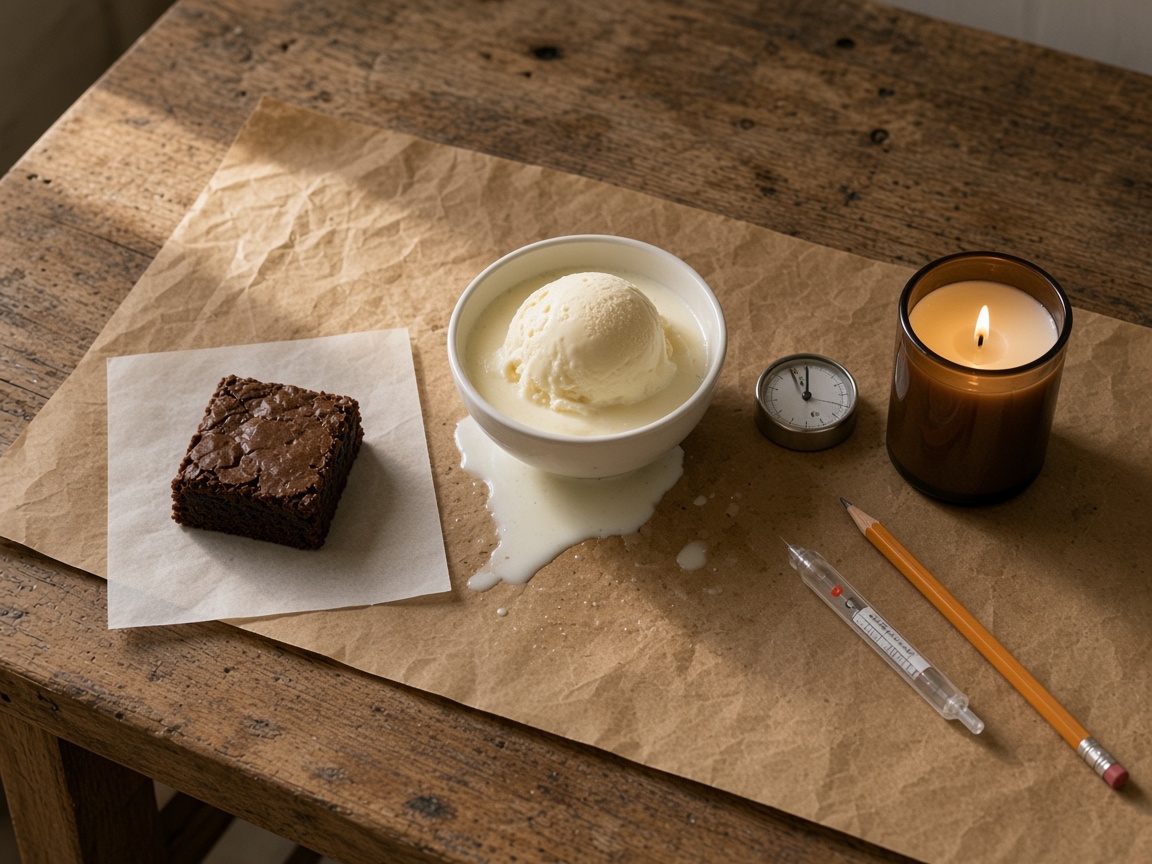
On May 28 we tested a theory June would like it known she did not propose. If the top note was cold cream, perhaps actual cold, placed near the melt, would give the note something to refer to. At 1:02 p.m. Martin bought a pint of vanilla ice cream at the market on Hyde and Union for $6.40. At 1:48 he set the bowl 14 inches from a lit pour 23. The bench was 68°F. The ice cream slumped into the bowl at 11 minutes and 40 seconds. The candle smelled the same at minute 11 as it had at minute 1.
We recorded the result as “not how cold works.” At 3:12 p.m. the panel ate the ice cream, except June, who was still smelling things and did not want a palate. The division was uneven. Ruben took the end. Pepper was not offered any, and applied, and was declined, which Teodora transcribed onto the back of the receipt because Pepper has a file too.
The same month, on May 14, we poured eight glasses to see whether a wick could be trusted to an eye that has been right for six years. Glass six could not. The wick sat 3 millimeters left of center. Standing on the left side of the room, Martin reached a full throw 9 minutes after the right side did. He stayed for the 9 minutes. Ruben started using a ruler the following Tuesday, and kept using his eye, so the eye would not retire angry.
One jar, on purpose
Pour 26, June 11, was a burn we mismanaged. The wick was not trimmed. At 2 hours and 17 minutes the ice cream note had become freezer burn. We logged it under our own names. A result we caused is still a result, and the care card’s instruction to trim to a quarter inch is there because of it, not because it sounds like care.
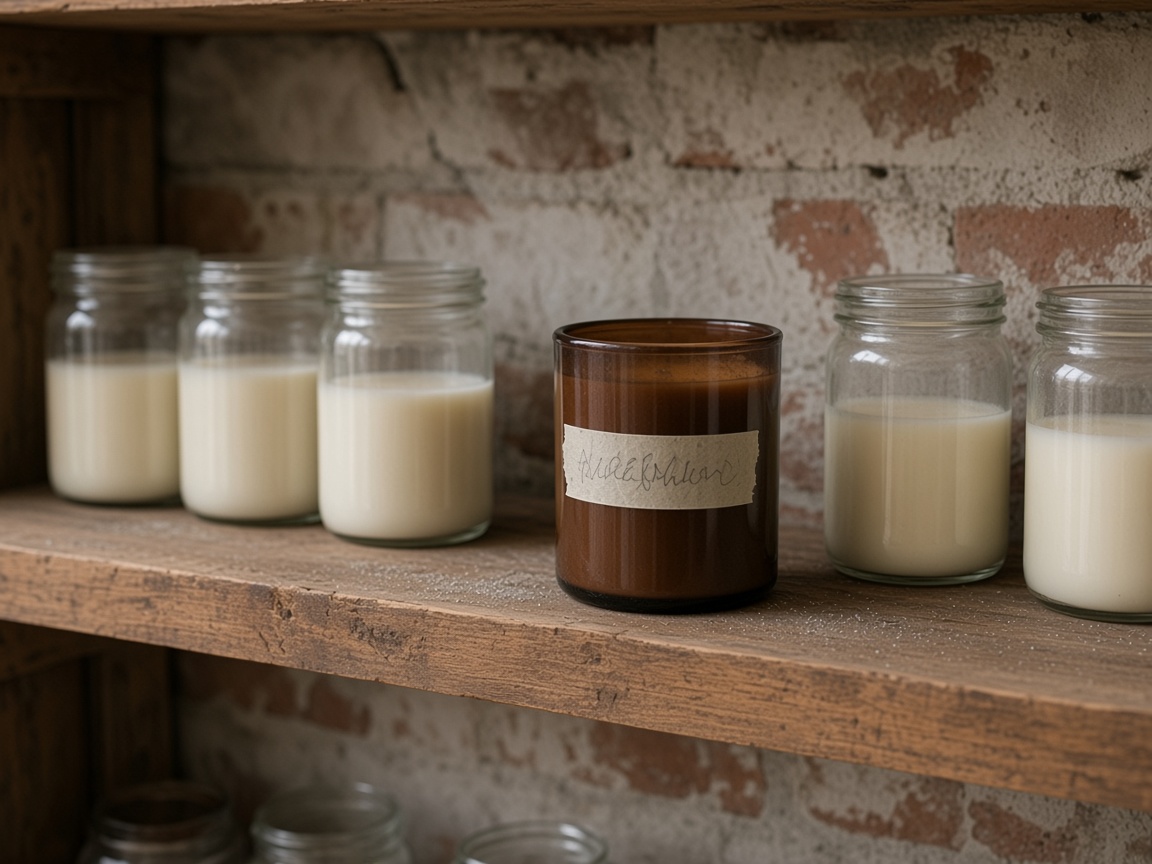
Pour 27 is the one we are asked about when someone sees the shelf. On June 18, at 3:40 p.m., we put 0.2 grams of brownie batter into a 200 gram melt. The idea, which we will state once, was that a real brownie might teach the accord something. The batter sank. The batter scorched. The room smelled like a baking sheet that had not been metaphorical. The glass was labeled, walked to the high shelf, and taken off the refill list the same afternoon. It is the only melt in which we have put food on purpose. The purpose is over.
A week later the stockist from Petaluma came back. He had thought about the 6. We gave him a spoon, because he asked, and then a brownie, because the spoon had been a misunderstanding we preferred to end with food that was food. He rated the brownie a 6 again and the candle a 9. Martin timed the quiet that followed: 40 seconds. Nobody filled it. June returned to Polk the next morning and bought two more brownies, “to be fair” to a bakery that does not know it is in this report. She rated them 7 and 6. The 7 was the corner piece. We have not built a correction factor for corners. We are not going to.
The vote
July 2 was the glass. Dye lot C-13 and dye lot C-14 were held to the north window at 11:18 a.m. for 90 seconds. C-13 looked like chocolate milk. C-14 looked like a brownie. Martin asked for 30 more seconds on behalf of the milk. We gave them. He agreed, and wrote the agreement without the extra clause he usually adds. C-13 went back to the supplier with a note that said “milk,” which the supplier understood at once. We were grateful for a correspondent who did not need the 30 seconds.
July 9 was the lid. “Not food” was set at 8 point, beneath a name set at 22 point. That afternoon three people at the counter asked whether they could eat the candle. The sentence was on the lid. They were hopeful, which is not a failure of reading so much as a success of the smell. We had no brownies in the tin. We had an apology, and we used it three times. The lid stayed as it was. We were wrong about that, and the postscript is the correction.
July 16, 4:41 p.m. Pour 31 was approved. June, Martin, Teodora, Ruben, and Lise voted yes. Pepper was asleep on the workshop table, was counted present because she was in the room, and abstained because she was asleep. Gerald had been invited to keep time and not to vote. His kitchen timer ran fast by 2.0 seconds an hour against his phone. The burn was 3 hours and 6 minutes, and also, by his phone, 3 hours, 5 minutes, and 53.8 seconds. He asked that both be written down. Both were. The full melt pool reached the glass at 2 hours 51 minutes. The care card says about three hours. He has noted the 9 minutes. The card has not been reprinted, because “about three hours” was the phrase the panel was willing to hand a customer, and the 6.2 seconds were a private matter between Gerald and the clock.
During that burn the refrigerator was opened 13 times, by four people, in 3 hours and 6 minutes. That is 4.2 openings an hour. We had not set out to measure wanting. Wanting measured itself. Someone said “should we” seven times. Someone stood up twice, both times for the refrigerator. The mean score for “is this a candle” was 5.0 on a scale we invented and did not show anyone. The mean score for “is this going to be a problem at a dinner” was 3.4. We shipped it with the 3.4 still attached. A candle that makes a person look for dessert is the brief, completed, and the brief did not say the person had to be comfortable about it.
At 4:52 p.m., eleven minutes after the vote, Martin conceded the cost. Glass $3.10, wax $2.35, wick and clip $0.22, fragrance $4.15, labor and overhead $1.14, and $0.41 of snacks. The snacks are $86.92 in Polk Street brownies and one Hyde Street pint, spread across the first 212 glasses, 212 being the length of a table we once lit and the largest number Martin trusts without remeasuring. The total is $11.37. Under eleven dollars was missed by thirty-seven cents and four pounds. The pounds are a footnote in the ledger and a sentence on the candle’s page, because he was not willing to leave them in the footnote, and neither were we.
Appendix A
The pour log.
All thirty-one. The dull ones are included. A log that keeps only the interesting lines is a story, and this already has a story further up the page.
- 01 Aug 19, 2025 · 10:40 a.m. Cocoa powder at 4 percent in soy. Dusty. June wrote “envelope” and closed the notebook.
- 02 Aug 26 · 11:05 a.m. Powder to 6 percent. “Envelope, sweet.” The sweet was sugar in the powder, which we had not intended to burn.
- 03 Sep 2 · 2:20 p.m. Tonka added. Martin wrote “a drawer.” He did not say which drawer. We have not asked, on the theory that some notes are complete.
- 04 Sep 9 · 11:30 a.m. Beeswax raised to 15 percent. The body improved. There was still no brownie. There was a candle, which we recorded as if it were news.
- 05 Sep 16 · 3:05 p.m. Salt, before we owned a tenth-gram habit. “A pretzel that has heard about chocolate.” Retired as a direction.
- 06 Oct 9 · 11:16 a.m. Dutch-process cocoa, bloomed in wax for 20 minutes at 185°F. The first brownie. Teodora described her response as professional, which she defined as once.
- 07 Oct 16 · 2:14–2:55 p.m. The same formula, unlit, in a closed Civic at Vallejo and Jones. Cabin 71°F at the start, 109°F at minute 27, removed at minute 41. “A brownie that has given up.” See the car.
- 08 Oct 23 · 1:40 p.m. Less cocoa. The panel wrote “milk” and then, to be fair, “chocolate milk,” and then crossed out the chocolate.
- 09 Oct 30 · 4:02 p.m. More cocoa. “A baking sheet left in the oven overnight.” End of the powder era. The sheet was metaphorical. The feeling was not.
- 10 Nov 13 · 11:00 a.m. No scent. A control, while we waited on the shipment from Ghana. It smelled like a candle. We wrote that down too. The window latch stuck at 1.5 inches during this test and we stopped arguing with it.
- 11 Dec 4 · 2:30 p.m. First sample of cocoa absolute, 0.2 grams in a 100 gram melt. Teodora’s aunt, unprompted, said “the church basement, but kindly.” We took the kindly and left the basement.
- 12 Dec 11 · 11:22 a.m. Absolute at a heavy hand. Ashy. Humidity that morning was 92 percent, and the cocoa went muddy with it. We did not yet know which of those was the cause. Later we decided: both.
- 13 Jan 8, 2026 · 10:50 a.m. Lot GA-2208 arrives. First proper dose, 0.18 grams to the glass, scaled. June wrote “yes” and did not elaborate for three lines. The fourth line is the formula we still use.
- 14 Jan 15 · 3:18 p.m. A tenth of a gram more cocoa. Bitter, in a way we liked and did not trust. Kept on the shelf as a reference for what “too far” means.
- 15 Jan 22 · 11:44 a.m. A piece of walnut, steeped 12 minutes and removed. The walnut stayed in the room until Friday. The following Wednesday, Ruben opened a Sonoma Hive and asked why the hive had been in a kitchen.
- 16 Feb 5 · 2:06 p.m. Brown butter, no cocoa. 227 grams of unsalted butter, 6 minutes 12 seconds, milk solids the color of a manila folder. A wick held 8 inches above the pan for 45 seconds. That wick was then a problem for three days.
- 17 Feb 12 · 1:15 p.m. The brown-butter accord, which is a material and not butter, at 0.94 grams to the glass, with the cocoa. “Breakfast near a brownie.” The nearest we had been.
- 18 Mar 3 · 11:07 a.m. Destroyed. The notebook said 4.1 grams of cocoa absolute. The target was 0.09 grams. The 4.1 was a biscuit. Caught the next morning at 9:40. Cost $30.54. See five whys.
- 19 Apr 2 · 3:33 p.m. Vanilla. Target 0.22 grams. Delivered 0.80 grams. The pipette was sticky from pour 17 and had not been washed, which is on the card now. Martin wrote “mall” and underlined it twice.
- 20 Apr 9 · 11:42 a.m. Reference brownie from Polk Street, $4.75, still warm. Set beside pour 17. A stockist from Petaluma rated the brownie a 6 and was not supposed to be rating the brownie.
- 21 Apr 16 · 2:00 p.m. Vanilla back to 0.22 grams. The ice cream note appeared, stayed for nine minutes, and left. Teodora wrote “it waved.” We do not have a better verb. We looked.
- 22 Apr 22 · 2:11 p.m. Blind. Teodora, fourteen seconds: “Sunday.” Humidity 41 percent. The bench scale read 200 before a 0.09 gram drop that could not have changed it. Photographed anyway.
- 23 May 7 · 11:30 a.m. A repeat of 22, to learn whether Sunday was a mood. It was not. Ruben said “a different Sunday,” which we accepted as confirmation and not as a new flavor.
- 24 May 14 · 4:05 p.m. Eight glasses. One wick sat 3 millimeters left of center. Hot throw on the left side of the room was 9 minutes shorter. Martin stood on that side for the 9 minutes, to be thorough and also to be unhappy.
- 25 May 28 · 1:48 p.m. A pint of vanilla ice cream, $6.40, placed 14 inches from the flame, to see whether cold would anchor the top note. It melted in 11 minutes 40 seconds. The top note did not move. Eaten at 3:12, except by June.
- 26 Jun 11 · 10:15 a.m. Burned 2 hours 17 minutes without a trim. The top note became freezer burn. Our fault, logged anyway, because a failure we caused is still a result.
- 27 Jun 18 · 3:40 p.m. 0.2 grams of actual brownie batter in a 200 gram melt, “to see.” It sank. It scorched. The glass was retired to the high shelf. We did not see anything we needed, except the end of the idea.
- 28 Jun 25 · 11:05 a.m. The Petaluma stockist returned, was given a spoon, and was then given a brownie. Brownie 6, candle 9. Martin timed the silence that followed at 40 seconds. The bakery was not told. June went back the next day and bought two more, “to be fair.” She rated them 7 and 6. The 7 was a corner.
- 29 Jul 2 · 11:18 a.m. Glass. Dye lot C-13 held to the north window beside C-14 for 90 seconds, plus 30 more because Martin asked to be fair to the milk. C-13 is chocolate milk. C-14 is a brownie. C-14 stayed.
- 30 Jul 9 · 11:11 a.m. Lid, first version. “Not food” at 8 point, under the name at 22 point. Three people at the counter still asked if they could eat it. The words were present. The hope was stronger.
- 31 Jul 16 · 4:41 p.m. Approved. Five yes, zero no. Pepper was on the table, asleep, counted present, and abstained. Gerald’s timer was 2.0 seconds fast per hour. Over 3 hours 6 minutes, that is 6.2 seconds. Both times are in the book.
Appendix B
Instruments, and the times they were wrong.
- Pipette
- Pour 19 delivered 0.80 grams of vanilla against 0.22. The pipette had been used for the brown-butter accord and not washed. It is washed now, and the wash is a line on the card, not a memory.
- Wick
- Pour 24, glass 6 of 8, 3 millimeters left of center. Nine fewer minutes of throw on the left side of a 990-cubic-foot room. We now use a ruler, and also the eye, so the eye stays employed.
- Timer
- July 16. Kitchen timer fast by 2.0 seconds per hour against Gerald’s phone. Accumulated error over 3 hours 6 minutes: 6.2 seconds. He asked that the record show 3 hours 5 minutes and 53.8 seconds. It shows both.
- Car
- 2008 Civic, not lit. 41 minutes, windows up, cabin from 71°F to 109°F. The car smelled like a bakery until day 6. June’s partner asked on day 2 whether she had taken a delivery job. She said no, which was accurate and insufficient.
- Butter wick
- Held 8 inches over the pan for 45 seconds on February 5. Still smelled like brown butter on February 8. Ruben nearly wicked a Sonoma Hive with it. He stopped because the hive smelled like breakfast, which is not one of its notes.
- Ice cream
- 14 inches from the flame. Slumped at 11 minutes 40 seconds. Bench temperature 68°F. The top note was unchanged, which is not how anyone hoped cold would work, and is how cold works.
- Batter
- 0.2 grams. Sank, scorched, retired. The only food that has been in one of our melts on purpose. The purpose has been retired with the jar.
- Scale
- Beaker 86.4 grams, wax 113.6 grams, bench scale 200. The cocoa drop was 0.09 grams. A whole-gram scale cannot see it. The photograph is labeled “proof.” It proves the sentence you just read.
- Latch
- 1.5 inches, since November 13, when it stuck and we measured the stick instead of fixing it. The matchbook we measured with lives in the drawer Martin called a drawer.
- Chair
- Moved, March 4, 9:55 a.m. Pepper was not interviewed. No one was written up. The chair was the corrective action, and it has held.
Postscript, October
The lid, after the shelf.
The study closed on July 16. The candle met the public on October 6. The public, in one case, took a bite. That incident is not a pour, and it changed the object, so it is in the report.
On October 11 a customer discovered, by a direct method, that the candle is wax. They were not hurt. Soy wax is non-toxic, and it is still not something we want in a mouth. The lid at that time said “Not food” at 8 point. The name above it was 22 point. We had already watched three people in July ask the same question without biting, and we had called the lid finished.
On Tuesday, October 13, the words were set at the same size as the name, for batch 26-131. Teodora looked at the proof from 2:20 to 2:24 p.m. and said, “It is loud.” We kept the loud version. A lid that can be read across a table is a lid that has accepted the brief. The brief was dinner. Dinner is how people end up hoping. We would rather be loud than be a surprise at 1 a.m.
Lise has been writing a card for each box, by hand: “Dessert is not included.” As of this morning she had written 340. Her handwriting has gotten worse. The sentence has not. The cards are not in the cost of goods. Martin proposed it. He was defeated, 4 to 1, with Pepper asleep and not counted, because we have learned something about counting sleep.
What ships
Decisions still in force.
- Pour 31 formula, including 0.18 grams of cocoa absolute and 0.04 grams of salt. June In production
- Cocoa glass, dye lot C-14. C-13 returned to the supplier with a note that said “milk.” Martin In production
- Thursday tests, ruler plus eye, washed pipettes, chair pushed in. Ruben In the card
- “Not food” on the lid. Enlarged after the shelf, see the postscript. Teodora Batch 26-131
- Snacks inside the cost of goods. The four pounds in a footnote, which the website then promoted. Martin Conceded at 4:52 p.m.
- No batter. No lit candles in cars. No biscuits on the scale. Everyone Holding
- The jar from pour 27, on the high shelf, tape outward. June Do not refill
Brownies & Ice Cream is on the bench at 628 Vallejo Street and with the stockists who asked for it, including the one who gave the brownie a 6. The full formula above is the production formula. The retired jar is not for sale. The Civic has smelled like a car since October 22, 2025. Reference brownies, when we need one, still come from Polk Street, and we are still not a bakery.
About Hale & Wick
Hale & Wick is a candle company founded in 2014 by June Hale and Martin Wick. Every candle is poured by hand, forty at a time, at 628 Vallejo Street on Russian Hill in San Francisco. The company employs a small staff and one shop dog, who is not permitted on the scale.
Media contact
Martin Wick, Operations · (415) 555-0148 · 628 Vallejo Street, San Francisco, CA 94133. He has the spreadsheet, and he will show it to you. This is a promise, not a threat, though it has been received as both.
###